Frequently Asked Questions
-
How does my box office staff book phone and mail orders using TicketStage?
-
Does TicketStage provide for both "reserved seat" and "general admission" ticketing?
-
How is online seat availability coordinated with box office seat availability?
-
Our group performs in multiple venues. Can TicketStage handle multi-venues?
-
Can I add marketing questions asking patrons how they found out about our show?
-
Sometimes we have to reassign seating. Can TicketStage do this?
-
How do we interface TicketStage to our existing computer system?
-
Nothing happens when the patron clicks on the Confirm Order button at the end of the order process.
- Can we use TicketStage to process membership or subscription orders?
How much does it cost?
TicketStage's approach is to provide online and box office ticketing at no net cost to the theater and at a small incremental cost to patrons.
No investment is required. This assumes the theater has a web site and a computer with internet access. No additional hardware or software is required.
Fees are structured to each theater's profile. A common structure is to charge a fee for guest tickets ordered online or by phone and to charge no fee for subscriber tickets, mail orders, and window sales. Fees are from $2.00 and up per ticket for this structure.
How are credit card transactions processed?
Ticket purchases are charged by and credited to MMCIS/TicketStage. Since we submit the charges real time, the information is checked and the order process cannot proceed to completion without good credit information.
Once credit card orders start for a show, TicketStage will issue a check/direct deposit to the Theater approximately every two weeks. The check/direct deposit will be for the amount of the tickets orders, minus TicketStage’s handling fee, for which TicketStage has received settlement from Authorize.net, our merchant account provider. The box office can see a report for each check/direct deposit that lists the orders that are included in that amount.
If the current amount due is less than $100 and the show is not complete, TicketStage may choose not to issue a check at that time.
Since credit card settlement usually occurs with 2-5 business days after the order is placed, the biweekly settlement will normally include all the new orders placed up through the Sunday before the check issuance.
How does a patron order tickets On-Line?
Patrons start at your theater's website viewing show and performance information. To order tickets patrons click on a buy tickets button "link" which brings up the ticket ordering screen for your theater. This is actually TicketStage, but looks like a part of your theater's web site. The patron then selects the show and performance he wishes to order tickets for. The next step depends on the type ticketing for the performance.
For reserved seat ticketing, the patron is presented a seating chart showing seats available. The patron chooses seats he wishes to order by simply clicking on those seats. Once seats are selected, the patron is presented with an updated seating chart confirming the seats selected are available and put on temporary hold for his order.
For general admission ticketing the patron is presented with the ticket pricing levels available. The patron enters the quantity of tickets wanted at each level. TicketStage confirms the tickets are available and puts them on temporary hold for his order.
The patron then identifies each ticket as a subscriber ticket or guest ticket. The patron next enters name, address, contact, and credit card information. The patron is then presented with a summary of his order for review and acceptance. Upon accepting the order, a detailed invoice is displayed confirming his order. The patron is also sent a confirming invoice by email that can be used as a ticket.
How does my box office staff book phone and mail orders using TicketStage?
The logged in box office person first selects the show and performance which causes a seating chart for the selected performance to be display. Both general admission and reserved seat tickets are booked using a seating chart. For general admission performances each seat represents a ticket and not a specific seat location. The box office person selects the seats/tickets he wishes to sell by clicking on unsold seats. Seat selections are confirmed by an updated seating chart showing the seats selected placed on temporary hold. Subscriber identification is next entered for subscriber seats/tickets. TicketStage automatically confirms subscriber credits/discounts and adjusts prices accordingly. Entering the ordering person's identification and credit card information completes the order. An order summary is displayed for final review, editing, and acceptance. Upon acceptance, the order is confirmed, credit card charged, subscriber credits/discounts usage logged, and an invoice displayed available for printing.
Our box office staff usually handles phone orders from their homes. How can we continue to do this with TicketStage?
TicketStage is accessible from any home computer having internet access. TicketStage provides for multiple box office staff to simultaneously enter orders.
How do shows and performances get set up in TicketStage?
Theater staff set up shows, performances, and control accessibility for online ordering using the box office functions of TicketStage. It is very easy to do.
A show is set up by simply entering a show name.
Performance setup involves entering the date and time of the performance, selecting the venue, selecting the type ticketing (general admit or reserved seating), setting prices, and reserving seats/tickets. A venue is chosen by clicking the one you want from a list of predefined venues setup for your theater. The type of ticketing is selected by clicking the type you want. You can set multi-level pricing (adult - senior - child) for each seat/ticket by entering the price along with a title.
Who provides tickets and how are they handled?
With TicketStage a theater can eliminate most ticket handling. TicketStage provides an email confirmation for all online orders and can provide an email confirmation for box office orders that include an email address. These email confirmations can be used as tickets. A theater can choose to obtain and handle tickets in the same manner as they did before TicketStage, or use a combination approach.
TicketStage facilitates ticket handling by providing a work list of orders to be ticketed and by keeping track of ticket status for each order. As tickets for each order are mailed or held, the ticket status is updated accordingly.
TicketStage also facilitates printing envelopes and invoices by providing a downloadable file of orders to be ticketed. By merging this file with a template using Microsoft Word, your theater can batch print envelopes and invoices.
Does TicketStage provide for both "reserved seat" and "general admission" ticketing?
Yes. For each performance you have the choice of setting up reserved seat or general admission ticketing. For a show you can setup both reserved seat and general admission performances.
How do I manage seat availability?
Seats can either be "available", "reserved", "sold" or "held"
-
Available means the seat is for sale online and by the box office.
-
Reserved means the seat is for sale only by the box office.
-
Sold means a confirmed order bought the seat.
-
Held means the seat has been selected for an order that has not yet been completed. Seats are held for a minimum of 15 minutes.
Patrons (online ordering) see seats as either available or unavailable. "Reserved", "sold" and "held" seats are shown as unavailable.
Seat availability is managed using two TicketStage tools:
Performance Seating Chart: The box office staff can flip the status of seats between reserved and available whenever they wish, thus controlling what seats are available online.
Default Seating Chart: When a new performance is set up it starts out with the default seating chart. The box office staff can modify the default seating chart at any time. Changes to the default seating chart do not affect the seating charts of performances already setup.
How is online seat availability coordinated with box office seat availability?
If TicketStage is used to book all orders, seat availability coordination is automatic and instantaneous.
If box office orders are handled on a separate system, seat availability coordination is handled by defining "available" seating only for online orders and "reserved" seating only for box office orders. The box office staff then coordinates availability by flipping the status of seats between reserved and available whenever and as often as is needed.
Our group performs in multiple venues. Can TicketStage handle multiple venues?
Yes! As you setup each performance you simple choose which venue the performance will be at. TicketStage's multi-venue support is ideal for theater groups who may not have their own space.
Can I add marketing questions asking patrons how they found out about our show?
Yes. TicketStage will add your specific marketing questions to both your online and box office order forms. An online report will provide an up to the minute tally of the responses to your questions.
Our season subscribers select the performances they wish for each show as it is staged. Can TicketStage recognize subscribers, check, apply and debit their seating credits/discounts automatically?
Yes! When seats/tickets are being ordered for subscribers, subscriber identification information is entered for each subscriber ticket ordered. Credits/discounts are automatically checked, applied, and usage logged.
Our subscribers often order additional tickets for friends. Can both subscriber and guest tickets be ordered together?
Yes. Each ticket in an order is selected as a guest or subscriber ticket and is priced accordingly.
Our Season subscribers select a performance series and are assigned the same seat for all performances. Can our subscribers change performances and seating online?
Not online! However TicketStage provides box office functions for your staff to reassign performance and seats on an existing order.
Sometimes we have to reassign seating. Can TicketStage do this?
Yes! TicketStage provides box office functions to edit existing orders. Both performance and seats can be changed. The seats originally ordered are reset to "available" status.
Sometimes we cancel ticket orders. Can TicketStage do this?
Yes! TicketStage provides a box office function to cancel orders. Seats are released and the order saved in a canceled order file. Subscriber credits are readjusted but no financial adjustments are made.
How do we interface TicketStage to our existing computer system?
TicketStage provides for exchanging data files with the theater's computer system over the internet. All order and customer data is available for downloading to the theater's computer. Membership/Subscriber data files are uploaded to TicketStage to provide automatic credit/discount handling, and downloaded for usage accounting. Data file exchanges are controlled by easy to use TicketStage commands. Exchanges typically only take a few seconds to complete.
Our Theater does ticketing manually. We don't want to change but would like to add Internet Ticketing. How can we do this?
TicketStage is flexible and easily set up to provide online ticketing for theaters ticketing manually. Order reports make it easy to keep track of and record internet orders onto the theater's manual system. On-Line seat availability is instantly and continuously changeable directly by the theater, providing coordination with the manual system. A theater website and use of a computer with internet access are prerequisite to implement this approach.
Our theater is not ready for online ticketing, but would like to consider TicketStage as our box office system and add online ticketing later. How can we do this?
TicketStage can be used as a box office system only. All that is needed is a computer with internet access. The computer does not have to be dedicated to TicketStage. If your box office staff typically handles phone orders from home, they can use their home computers to book orders on TicketStage. If you have more that one person handling orders at the same time, TicketStage provides for multiple box office staff simultaneously entering orders. Since TicketStage includes online ticketing, it can be implemented whenever your theater is ready.
What do I need to use TicketStage?
To access and use the TicketStage box office, a computer with a current Internet browser and Internet access are the minimum requirements. The computer does not have to be dedicated to TicketStage. No additional software or hardware is needed.
To implement TicketStage online ordering, a theater must have a website or social media page. TicketStage is added to a theater's website by adding an Internet link to the site. Adding this link is simple to do and usually costs nothing.
What skills do I need to use TicketStage?
Experience using computers and accessing the internet using a current web browser (Chrome, Edge, FireFox, etc. ) is all that is needed. No special skills or programming experience is required
What do I do when a patron reports that he or she has been charged multiple times for the same order?
In some very infrequent cases, an order is charged for twice. In that case, report the order number to webmaster@ticketstage.com and a credit will be issued.
Far more often, the patron is seeing the result of one or more declined transactions. This requires a little explanation. Credit card transactions are done in two steps: authorization and capture. Authorization validates the card information and verifies that there is enough credit in the account to pay the order total. Capture actually moves the money from the patron's account to the TicketStage account (the money takes 4-7 days to move). When a transaction is declined for some reasons, such as Address Verification System mismatch, or wrong or missing card security code, the authorize step is completed but the capture step is not. That means that the issuing bank has put a reserve on the account for the amount of the transaction. This is done because we (as the merchant) have the ability to tell the bank that we want to process this transaction even though it had the address or security code failure. We generally do NOT exercise this right since we would be charged a higher fee.
Those reserves will be voided within 3-5 banking days (set by the issuing bank) if the transaction is not captured. In the rare case that someone has maxed out their card because of these declines, call your bank and find out what their process is for releasing those authorizations. Some banks require the cardholder to make the request, some the merchant (us), and some just don't do it. For us to do that we need the customer support number for the card issuer from the back of the credit card used. It bears repeating that not all banks comply with such a request.
Address Verification System (AVS) errors are generated by the card issuing bank. We have no control over that. Most of the time the patron has not used the street address and ZIP that exactly matches the address on the most current bill. We have seen a few cases of the bank's system not being up to date as well.
Nothing happens when the patron clicks on the Confirm Order button at the end of the order process.
If a patron reports that nothing happens when they click on the Confirm Order button at the last step of the order process, they most likely have a popup blocker on for the site. Clicking on the Confirm Order button executes a little javascript that makes the button unavailable by swapping layers. This reduces that chance that it will be clicked twice, resulting in a double charge. Have them turn off any popup blockers either for the TicketStage site or completely while they are completing the order.
Can we use TicketStage to process membership or subscription orders?
Yes, TicketStage supports the ability to process membership or subscription orders, including additional donations or other special collection types.
Subscription or Membership Orders
|
By membership or subscription orders, we mean an order for seats to each show of the season, or some subset of all the shows of the season, usually at a reduced price from the individual seat price. Currently TicketStage treats the membership order separately from the seat assignment for any of the performances. The basic flow is:
With the recently added functionality of cloning an existing order, the boxoffice does not have to re-enter the patron information for each of the performance orders. A patron would have to re-enter their identifying information but would not have to enter payment information if all the seats are paid for by the membership. Additional Order CapabilitiesIn addition to containing order fields for the various combinations of show tickets, the membership order can be used to solicit donations or other non-seat related income. The membership order can have additional fields specified by the theater, including the marketing questions, or a field to request a particular seat if seats are to be assigned by the boxoffice. Handling feesThe handling fee for the show seats is the same as for individual patron orders. There is a 4% handling fee for the non-seat related portion of the order. As is true for the regular ticket sales, the theater can let the patron see the handling charges or any portion of them. For instance, the seat related handling fee can be explicit on the order, and the handling fee for the donation part can be hidden. What TicketStage needs to set up a membership orderWe need the order information. Typically you would just send us a copy of the printed membership order form. We would create a special performance record for the membership ordering. This would then appear on the appropriate performance lists in the boxoffice (e.g., Order selection for display or download). Once we make the membership order Active, anyone going to your patron TicketStage address (https://www.ticketstage .com/XXXXX) would see the membership order link at the top of the available performances. What is not implementedThe patron cannot select seats during the membership order process. Seat selection must be done separately. The exact pricing for the membership seat is not included in the reports for the show or performance. A separate report details the membership orders. Some examplesPatron picks seats for each performanceTheater A offers a membership for all 4 of the shows in their season. Each membership entitles the patron to one seat at any performance for each show. The cost for a membership is $50, a $10 savings over the $15 regular price for the shows. The membership order invites patrons to make a donation in addition to purchasing the membership. Patron 1 completes a membership order for 2 memberships plus $100 donation. The patron is charged $50 + $7 handling fee (4 x $1.75) + 100 = $157. The theater net is $50 + $97 ($100 - the 3% fee) = $147. After completing the membership order, the patron immediately enters 4 new orders, one for each of the performances he/she wants to attend. For 3 of the orders, he/she selects two seats and selects Membership as the pay type for each. In the information box next to the paytype, he/she enters the membership order number as the validation for using membership as the paytype. Since the order total is zero, the patron is not prompted for any payment information. On the 4th order, he/she orders 2 additional seats, selecting membership as the paytype for the first two seats, and credit as the paytype for the 3rd and 4th seats. Since the order total is not zero the patron is prompted for payment information, and is charged for the 2 extra seats. Boxoffice assigns seats for each performanceTheater B offers a membership for all 6 of the shows in their season. Each membership entitles the patron to one seat at any performance for each show. The cost for a membership is $100, a $20 savings over the $20 regular price for the shows. The membership order invites patrons to make a donation in addition to purchasing the membership. Patron 2 completes a membership order for 2 memberships plus $100 donation. The patron is charged $100 + $10.50 handling fee (6 x $1.75) + 100 = $210.50. The theater net is $100 + $97 ($100 - the 3% fee) = $197. Sometime after the membership order is received, the boxoffice edits the membership order, uses the Clone this order button at the bottom of the edit order screen to create a new order with all the patron information the same. The boxoffice person selects the first performance, assigns the seats, and then updates and confirms it, sending a confirmation email if appropriate. This step is repeated for each of the performances the membership is entitled to. |
Membership Pay Type
|
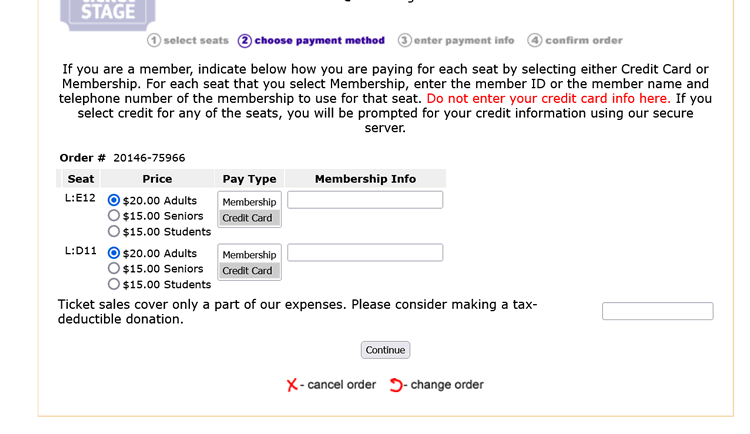
The way TicketStage handles allowing members or subscription patrons to pay for seats using the membership is a two step process. Once TicketStage enables membership paytype for the theater, the payment selection step of the patron order process will present a drop down box with credit card and membership as the paytype for each seat in the order. Typically the theater will instruct members to enter some identifying information such as their name and telephone number in the membership information field. If the theater uploads the membership information to TicketStage, including an email and password then the system can do the authentication of memberships seats when processing the order. See details below at Order time membership authentication
By default, the system does NOT do any authentication of this membership information. See below for Order time membership authentication. The patron can, of course, purchase other seats on the same order and pay for those by credit card. The system sets the price for membership paytype orders to $0. The second step is done by the boxoffice. For each order that specifies a membership paytype, the boxoffice must authenticate the validity. This can be done manually or by uploading membership information, including the number of tickets the member is entitled to for each show. If no database has been uploaded, the authentication consists of reviewing the orders and leaving those that are valid alone. If a member database has been established, edit the order and for each membership paytype, enter the membership number on that line and then hit update and confirm. The system checks the Seat Credit field in that member's record to see:
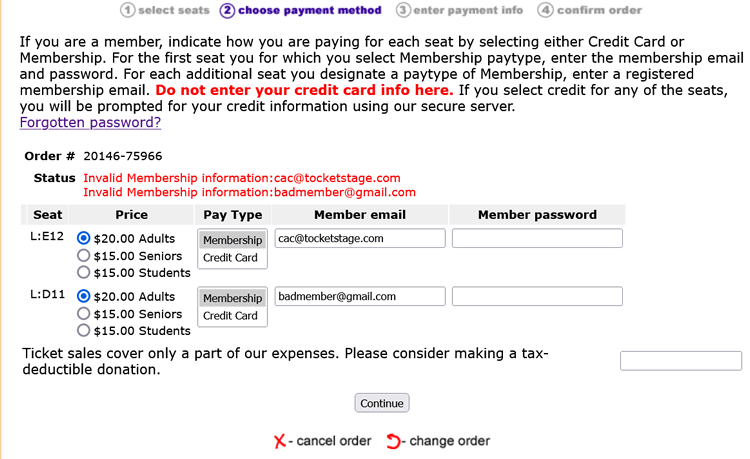
If so, then the system accepts and sets the order to confirmed. If not it puts an error message in that row saying there are not enough seat credits left for this show. If a patron incorrectly tries to pay for a seat with a membership, the theater is responsible for contacting the patron and getting payment. If the order only has membership paytypes, the boxoffice can take payment information over the phone or in person and update the order. If the order is closed because other seats in the order were charged to TicketStage's merchant account, then the boxoffice can get permission from the patron for TicketStage to charge the required seats to the same credit account. To request this, edit the order, and use the Change Closed Order Request link. Order time membership authenticationIn order to have the system authenticate membership information and assess available seats for a show, the member database must be loaded with the member information, including a valid email and password. We would work with the theater to establish the best method for assigning initial passwords and maintaining that information, as well as developing the instructions that would be used to inform the members how to use the new validation. We will give the theater a new address that patrons can use to updated their membership information online, including changing their passwords. Anytime a member changes his/her information, the system will email the designated membership manager for the theater. Once a theater has chosen to do order time membership authentication, the order process for membership seats will request that the patron enter the registered email and password for the first membership seat and the registered email for the remainder of any membership seats on that order. If the email and password for the first membership seat are correct, and the emails given for any other seats are matched to the member records, the system will process the order normally with no alerts. The membership data base will be updated according to the seats used. If the membership email and password entered for the first membership seat is valid, the system will populate the order patron information from the member record. The patron can change any of the order information. If an email is associated with more than one membership record, the patron must enter the email and password for each such membership seat. If the email/passwords entered are not valid, or the designated memberships do not have sufficient available seat credits, the system displays the error and the patron can make the correction, or switch the payment type to credit card.
See a sample instruction letter to members, explaining how to use order time membership authentication.
|